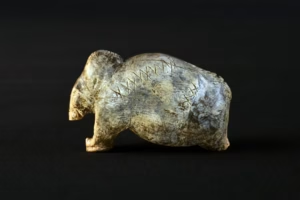
Symbols found carved into 40,000-year-old German artifacts may be precursor to writing | CNN

This is roughly twice as old as the oldest previously known proto-language (which among other things carried calendrical information about animal mating and birthing seasons). It’s mind-boggling to me that humans used abstract marks to carry information for tens of thousands of years before inventing true written language. Although I imagine the notion of ‘information’ would have been quite alien, which is part of why it was such a difficult leap.
The signs often occur in patterns — such as line, line, line or cross, cross, cross — which is not common in spoken language, according to the researchers. Some of the artifacts were discovered almost 100 years ago, but ongoing excavations are constantly unearthing new ones. Over the years, scholars have interpreted the markings to mean many different things, including hunting tallies, moon calendars, fur patterns or simply decoration.
“When I first had the result on screen, I could not believe it,” Bentz recalled about the moment he first looked at the computer analysis and saw a match between the older Stone Age markings and proto-cuneiform script found on more modern tablets from ancient Mesopotamia. “I sent a screenshot to my colleague.”
There seems to be a logic to the selection of symbols, according to Bentz. “On animal figurines, like mammoths and horses, but also on tools, we have crosses,” he said, “but we never find crosses on human figurines, so somehow there must have been a kind of taboo or convention to not put crosses onto human figurines.” Other studies have suggested that crosses could signify ritual killings, he added, so perhaps that’s why they weren’t found on sculptures of people.
Symbols found carved into 40,000-year-old German artifacts may be precursor to writing | CNN
Trees ‘remember’ wetter times − never having known abundant rain could buffer today’s young forests against climate change

Rainfall patterns are changing in many places. Individual trees adapt to the patterns they experience, so while the changes are hard on older trees, younger trees are better equipped for the new normal.
Trees experiencing drought alter their leaves, wood and roots in ways that prime them for continued dry conditions. Wood under drought might have smaller cells that are less vulnerable to future damage, and roots might increase relative to leaf area. These structural changes persist after the drought has passed and continue to influence the tree’s growth and ability to tolerate stress for many years.
Known as “legacy effects,” these lingering post-drought impacts represent an ecological memory of past climatic conditions at the tree and forest level. Knowing that trees hold a persistent memory of past dry phases, researchers wondered whether they might also show structural changes in response to past wet periods.
Eleven years after summertime irrigation started in Pfynwald, scientists stopped irrigating half of each plot in 2013 to address this question. The formerly irrigated trees, which at this point were about 120 years old, had experienced a lasting period of irrigation – but now those times of plenty were over.
Would the trees remember? A decade later, we found out.
First synthetic cell capable of replication
There are some important caveats, but this seems like a significant step forward in synthetic biology (for better and for worse).
Prof. Kate Adamala and her team at the University of Minnesota have built SpudCell, a cell-like system constructed entirely from known chemical components that can perform a complete cell cycle.
The system contains 36 purified enzymes, a 90,000 base pair genome spread across nine separate DNA molecules, and a lipid membrane. SpudCell is able to grow, replicate its genome, divide, and undergo selection and competition across multiple generations.
Unlike earlier work on minimal cells that carved down living cells, SpudCell is built entirely bottom-up from individually purified, non-living components. It is the first time such a system has demonstrated a complete cell cycle.
Source: Biotic | SpudCell
AI Will Make Human Art More Valuable | WIRED

One of the most nuanced pieces I’ve read on potential effects of AI art on artists.
The mistake is to assume that the meaning of “better” will stay the same. What’s more likely is that the goal posts will shift because we will move them. We have changed our collective tastes in response to technological progress in the past. We’ll now do it again, without even noticing that it’s happening. And if history is any indication, our tastes will evolve in a way that rigs the game in favor of human artists.It’s not surprising that in conceiving of a new world awash with AI art, we haven’t accounted for a society-wide change in taste. We tend to assume that in the future we will want the same things we want now, and that only the ability to achieve them will evolve. One famous study dubbed this the “end of history illusion”: People readily agree that their most strongly held tastes have changed over the past decade but then insist that from this point on those tastes will remain as they are. Having presumably reached some peak level of refinement, they can now rest idly in their self-assurance.In truth, what turns us on and off is constantly being reshaped by a range of powerful social forces, mostly beyond our awareness. Technological progress tops the list because it changes what is easy and what is difficult, and our running definitions of the beautiful and the vulgar are instantly affected by these criteria. When new advances expand the confines of what is possible, collective tastes respond—by wanting to partake of the new abundance and by wanting nothing to do with it.
Surviving in a poisoned land: Chernobyl’s wildlife is different, but not in the ways you might think

The story of how Chernobyl has affected wildlife is complicated, argues Jonathon Turnbull, a geographer at Durham University. You can’t just say nature in the exclusion zone is thriving or dying, he says: “There’s the spectacular story of ‘Chernobyl changed everything’ – that doesn’t go very deep.”
Rather, there exists a menagerie of subtle effects and responses. An entire ecosystem that experienced a terrible disaster but kept living and growing. It’s no surprise, says Turnbull, that so many questions still litter this landscape 40 years on.
https://www.bbc.com/future/article/20260424-chernobyl-wildlife-forty-years-on
New Education Scorecard Finds U-Shaped Recovery
In its fourth year, the Education Scorecard (a collaboration between the Center for Education Policy Research at Harvard University, the Educational Opportunity Project at Stanford University, and faculty at Dartmouth College) provides a mixed picture of American education: a post-pandemic math rebound and early signals that comprehensive literacy reforms are beginning to pay off, but signs that middle-income districts are lagging behind.
https://www.gse.harvard.edu/ideas/news/26/05/new-education-scorecard-finds-u-shaped-recovery
Some takes on love and dating among gen Z
https://thepointmag.com/examined-life/doomers-in-love/
‘I think of the notion of boysobriety—celibacy, in other words, rebranded with an infantilizing TikTok neologism. The desire to sober up from love and sex is pervasive among the first generation (mine) to fully combine the mores of free love with the more, more, more impulse of dating-app culture. Drowning in opportunities but dying for dignity, people my age and younger don’t want a relationship they can DoorDash. The turn to “trad” dating norms, Marxist-feminist theories and TikTok lifestyle advice reflects the desperation for a social or moral framework that gives them the permission and the confidence to say, without feeling too conspicuous or weird, “I’ve had enough.”’
…
‘..there is a reason that these seemingly arbitrary standards [about sex and dating] hold such appeal. The new technologies, we’re told, give us more freedom and choice, and they do. Yet they also undermine the moral and practical heuristics we need to know how to make a good choice. In the absence of norms or models, however imperfect, we turn each relationship into an elaborate contract dispute. Without a clear path or end goal we inspect little red flags along the road as signals for whether to end things, searching for decisive forks in a missing trail. Amid the collapse of authority on sex and gender, and in this radical freedom, we are all forced to become existentialists in dating, in blue-bubbled messages, on our endless social media feeds and in strained conversations: What do you want? Where are we going? What are we?’
NYT on lookmaxxing and gen Z’s world of sex and dating:
https://freddiedeboer.substack.com/p/the-incels-veto-and-other-observations
‘We’ve handed the sexual imagination of an entire generation of young men over to people who are profoundly and perhaps deliberately wrong about the nature of women and desire and human worthiness, and the cost isn’t just that those men are lonely. It’s that we’ve made sex and love feel like a rigid and robotic hierarchy when they are, at their best and most real, the most radical available argument against hierarchy altogether.’
https://archive.is/yj9xx (Shadi Hamid):
‘Over two-thirds of young adults have either not dated at all or only gone on a few dates in the last year. One of the main reasons? They lack confidence and don’t know how to approach the opposite sex…Henry Weng created Date Drop, a matchmaking platform that has swept through elite campuses. The premise is simple: answer a lengthy questionnaire about your values, preferences and political views, and the algorithm assigns you a single match weekly. No swiping, no infinite menu of options. Just one name…As the Wall Street Journal recently reported, roughly two-thirds of Stanford’s undergraduate population signed up…Only 1 in 3 young men say they feel comfortable approaching someone they’re attracted to, according to the dating recession report. And barely more than one-third of young adults say they can pick up on social cues during a date.’
What Makes Art Great?
I’m certainly not convinced that Qureshi has nailed the answer to this question, but I’m also not sure I could have done better, and it’s an interesting attempt.
This property of constantly destabilizing the reader is, I think, also a general property of great works of art. They are constantly breaking their own forms, subverting them, playing with the reader in a way that requires us to rise to their level. They are extremely strange. Think of the experience of reading Moby Dick and getting hit with sixteen pages of quotations about whales straight off the bat. New art finds new ways of doing this, which is why art is always this forward motion in which old forms get disrupted by new ones, and artists must continue finding ways to be original. Although I believe some texts are objectively better than others, and that this is demonstrable, I also believe that there will never be some exact recipe for generating more great texts, because one of the characteristics of greatness is that the next great work never looks like the last one.
Baroque Theorbo and Lutes
I hadn’t realized just how wacky the various baroque lutes were until now. I am very grateful that I don’t have that many strings to keep in tune.